
Federal Budget 2026-27: Hurney Partner’s Full Breakdown
What it means for individuals, investors, trusts & small business
The Federal Budget handed down on 12 May 2026 introduces some of the most significant tax changes in decades. While most major changes don't take effect until 2027 or later, there are important planning opportunities available right now.
Budget documents are often full of politician speak and spin. We’ve cut through the noise, broken down what actually matters – and what you need to know. In English.
Quick Navigation
At a Glance
$250 annual tax offset for workers
$1,000 no-receipt tax deduction
Major capital gains tax changes from 2027
New 30% minimum tax on discretionary trusts
Changes to negative gearing rules
Additional support for small businesses
Individuals
$1,000 Instant Work Deduction (from 2026–27)
Employees and sole traders can claim up to $1,000 in work-related expenses without keeping receipts.
Important points:
If your actual expenses are higher, you can still claim them with proper records
This simplifies tax returns rather than delivering a large tax cut
This is a deduction, not a refund — the benefit depends on your marginal tax rate
Example:
Tax rate: 32.5%
$1,000 deduction saves you $325 in tax
Tax rate: 45%
$1,000 deduction saves you $450 in tax
$250 Working Australians Tax Offset (from 2027–28)
Up to $250 per year for workers and sole traders.
What counts:
✅ Salary and wages
✅ Sole trader income
❌ Investment income
Capital Gains Tax (from 1 July 2027)
This is a big one.
The current 50% CGT discount will be replaced with:
Inflation-adjusted capital gains
A minimum 30% tax on real gains
Example — Before vs After
Scenario: Investment property held for 10 years
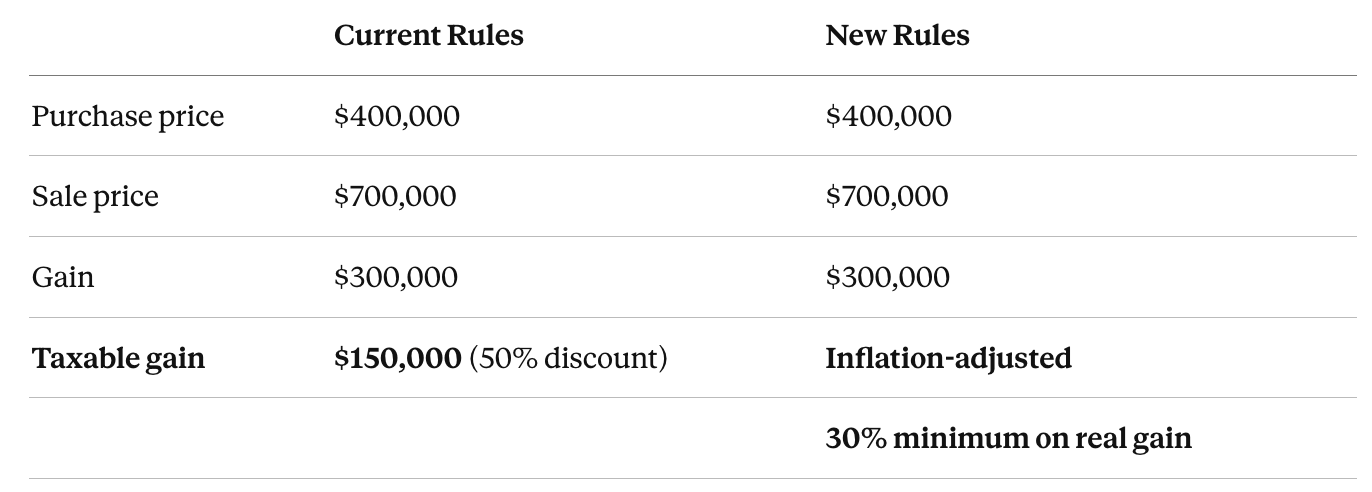
Capital Gains Tax Changes - Before/After Scenario
What this means:
Timing of sales will become increasingly important, particularly for long-held assets. In some cases, selling before July 2027 may save significant tax. In others, the inflation adjustment may work in your favour.
The verdict: Case-by-case. We can model your specific situation if you're considering selling assets.
Property & Negative Gearing
The Change (from 1 July 2027)
Negative gearing will be limited to new builds only.
Existing properties purchased after Budget night will have restricted deductions.
What Does "Restricted" Actually Mean?
Rental losses will be quarantined:
❌ Cannot offset against wages or business income
✅ Can be used against future rental income
✅ Can reduce capital gains when you sell
Example — Carry-Forward Loss
Year 1:
Rental loss: $15,000
Cannot offset wages
Loss carried forward
Year 2:
Rental loss: $8,000
Total carried forward: $23,000
Year 3:
Rental profit: $10,000
Apply $10,000 of prior losses
Taxable rental income: $0
Remaining loss: $13,000 (continues forward)
On sale:
Capital gain: $150,000
Remaining losses: $13,000
Taxable gain: $137,000
Key Points
✅ Existing properties are fully grandfathered
If you already own it, nothing changes.
✅ New builds remain fully negatively geared
Government wants to incentivise construction.
❌ Existing properties bought after Budget night
Quarantined losses only.
Should You Buy or Sell Now?
If you're considering buying:
New builds have a clear tax advantage
Existing properties may still make sense if cash-flow positive or close to it
If you're considering selling:
CGT changes from July 2027 may affect your decision
Timing matters more than it used to
Let's talk it through. We can run the numbers based on your actual situation.
Trusts — Major Changes
New 30% Minimum Tax (from 1 July 2028)
A new 30% minimum tax applies to discretionary trusts.
Who Pays the Tax?
The trustee pays 30% tax, not the beneficiary.
This is a fundamental shift in how trust income is taxed.
Example 1 — Individual Beneficiary
Trust income: $100,000
What happens:
Trustee pays $30,000 tax upfront
Beneficiary receives a $30,000 tax credit
Beneficiary lodges their return
If beneficiary's tax rate is 37%:
Tax on $100,000 = $37,000
Less credit = $30,000
Pays additional $7,000 ✅
If beneficiary's tax rate is 19%:
Tax on $100,000 = $19,000
Less credit = $30,000
Credit is non-refundable
Loses $11,000 ❌
Example 2 — Company Beneficiary
Trust distributes $100,000 to a company.
What happens:
Trustee pays $30,000 tax
Company receives no credit
Company pays 30% on the income again
Result: Potential double taxation on the same income.
Translation: The "beneficiary company" strategy is largely dead.
Why This Matters
Income splitting benefits reduced dramatically
Distributing to low-income beneficiaries is now inefficient
Company distributions face double tax
Higher effective tax for most family groups
Planning Opportunity
3-year restructuring window from 1 July 2027
You have three years to transition to:
Companies
Fixed trusts
Other structures
Important: This requires proper planning. Rushing into a change could trigger CGT or stamp duty.
We strongly recommend reviewing your structure now. We can model scenarios specific to your family group and business.
Small Business
Permanent $20,000 Instant Asset Write-Off
Applies from 1 July 2026
No more yearly uncertainty about whether the threshold will be extended. It's now permanent.
What this means:
Write off assets up to $20,000 immediately
Better planning certainty
Easier cashflow management
Loss Carry-Back (Companies Only)
Offset current year losses against profits from the previous two years.
Result: Cash refunds of tax you've already paid.
Example:
2025: Profit $200,000 → Tax paid $60,000
2026: Profit $150,000 → Tax paid $45,000
2027: Loss $100,000
Carry back against 2026:
Refund: $30,000 (30% of $100,000)
Start-Up Loss Refunds (from 2028)
Early-stage businesses may convert losses into refundable tax offsets.
This puts cash back into the business during the critical early years.
Details still to come — watch this space.
PAYG Instalment Flexibility
More flexibility to align tax instalments with actual cashflow.
Why this matters:
Reduces pressure during low-revenue periods
Improves working capital management
Less need to "find" tax money when cashflow is tight
What You Should Do Now
If You Hold Property
Consider timing of any planned sales (CGT changes from July 2027)
Review whether new purchases should be new builds vs existing
Model the impact of quarantined losses
If You Have a Trust
Book a review before the 2028 changes
Explore restructuring options during the 3-year window
Model scenarios for your specific beneficiary mix
If You Run a Small Business
Plan capital purchases around the permanent $20k write-off
Review loss carry-back opportunities (companies)
Assess PAYG instalment arrangements
Next Steps
If any of these changes may impact you, we recommend reviewing your position early.
The planning window is open now — but it won't stay open forever.
Get in touch if you'd like to discuss your specific situation.
We'll walk you through exactly how this applies to you — and what you should do about it.
Prepared by Hurney Partners
Accounting & Financial Services
Making tax less taxing.
Contact us:
📞 07 4061 1085
📧 enquiries@hurneypartners.com.au
🌐 hurneypartners.com.au